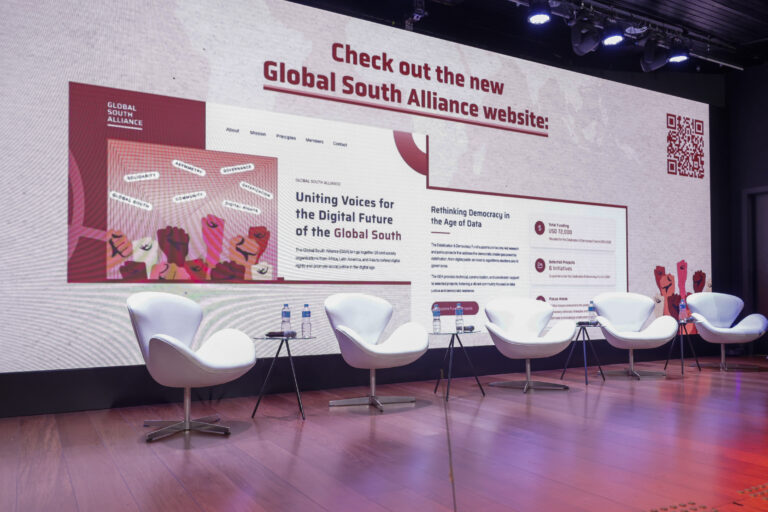
The Data Privacy Global Conference (DPGC) turns five, and its new edition is confirmed for December 7 and 8, 2026, at ESPM’s Álvaro Alvim campus in São Paulo. Organized by Data Privacy Brasil since 2022, the conference is today one of the Global South’s main forums for debating data governance, technology regulation and their impacts on fundamental rights. The first batch of registrations is now open.
DPGC was born in 2022 with an international character from the outset. The first edition brought together participants from several countries and featured Waldemar Gonçalves and Miriam Wimmer, then directors of the National Data Protection Authority (ANPD), which was still being structured at the time. Also taking part were Ana Brian Nougrère, United Nations (UN) Special Rapporteur on Privacy, and Tommaso Valletti, professor at Imperial College London. Since then, the conference has established itself as a multistakeholder space that connects the public sector, the private sector, academia and civil society.
In 2023, artificial intelligence regulation became a central axis of debate at DPGC, before the topic came to dominate Brazil’s public agenda. That edition welcomed Anita Allen, professor at the University of Pennsylvania, on her first visit to the country. In an interview with Folha de S.Paulo during the event, Allen drew attention to the errors of facial recognition systems and their effects on Black people.
In 2024, in the context of Brazil’s G20 presidency, DPGC recorded more than 400 in-person participants. That edition welcomed Nicolas Robinson Andrade, then head of public policy for Latin America at OpenAI; Edilene Lôbo, substitute justice of the Superior Electoral Court (TSE); and Diego Canabarro, Head of Privacy Policy at Meta in Brazil.
In 2025, the event’s format changed: panels in the morning and simultaneous workshops in the afternoon broadened the possibilities for participation. The Statute of Children and Adolescents in the Digital Environment (ECA Digital) took center stage in the program, with a joint keynote by Iagê Miola and Lorena Coutinho, directors of the ANPD. Between one edition and the next, the ANPD ceased to be an Authority and began operating as the National Data Protection Agency, with an expanded structure and broader responsibilities.
Across its five editions, DPGC has brought together more than 1,100 in-person and online participants, more than 300 national and international panelists and more than 200 organizations, including governments, regulatory authorities, academia, the private sector and civil society. Over its history, the conference has also gathered 90 sponsors and partners.
DPGC’s program follows the issues that emerge and develop in the field of data and technology: artificial intelligence regulation and governance, digital public infrastructure, protection of children’s and adolescents’ data, information integrity, cybersecurity, regulatory enforcement and digital sovereignty. These themes structure Data Privacy Brasil’s Theory of Change, which is organized around the concept of a fair information ecosystem.
The 2026 edition takes place at a moment of intense regulatory activity in Brazil, marked by the new decrees under the Brazilian Civil Rights Framework for the Internet (Marco Civil da Internet), the implementation of ECA Digital and the strengthening of the ANPD. When Data Privacy Brasil was founded in 2018, the LGPD was still a bill. In 2026, personal data protection is a consolidated part of Brazil’s regulatory culture. DPGC’s trajectory has followed this maturation: from an emerging forum to a space that brings together regulators, the market, academia and civil society to bring greater depth to these debates.
DPGC 2026 takes place on December 7 and 8, at ESPM’s Álvaro Alvim campus in São Paulo.
The first batch of registrations is open, with limited availability. The program is constantly being updated on the event’s official website: dpgconference.com.br.