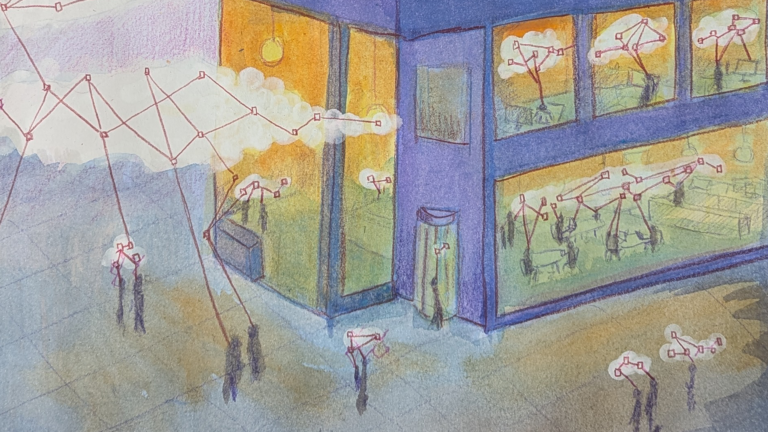
You have probably made a Pix payment or logged in to the gov.br platform. In our daily lives we use different services: we take a medical test at a laboratory whose results will be accessed by doctors, we use the Bilhete Único transit card, and we may even have integrated our bank accounts through Open Banking. All of these situations depend on a resource that allows users’ data to be shared across different systems: interoperability.
But why has it been gaining visibility? What benefits can it bring to public and private services? And what risks does it pose to the protection of citizens’ privacy?
Shall we try to understand these questions?
Where does the visibility of interoperability come from?
Data interoperability can be understood as the ability of different systems to exchange, integrate and use data efficiently and in a coordinated way, enabling continuous data sharing and improving collaboration, innovation and data-driven decision-making.
It decentralizes data, which is divided among different systems but can be accessed quickly. The ease of accessing this data from multiple sources simplifies information sharing, since users can access external data quickly and conveniently.
For example, imagine you need to pay a bill. If you use Open Banking, you can pay it with the balance of your connected accounts, instead of logging into each account separately and checking how much is in each one. The convenience that interoperability offers brings with it challenges related to privacy, security and fundamental rights when personal data is involved.
What benefits can it bring to public and private services?
In public services, interoperability has been emerging as an alternative to bureaucracy, enabling simpler processes, resource savings and faster service.
In Brazil, the Conecta gov.br program promotes the exchange of information among different government bodies so that citizens do not need to resubmit information the public administration already holds, avoiding data duplication. The program has generated more than R$16 billion in savings since 2020.
Another emblematic case was the Central Bank’s restructuring of the payment methods market, which eliminated exclusivity between card brands and acquirers in card machines and created conditions for new participants to enter this market.
In this case, it meant that card machines began accepting cards from all brands, making it possible for more acquirers to operate with different brands and expanding the options available in the market.
While this measure brought more competition, efficiency and innovation to the market, it also meant greater circulation of data among agents, making the exposure of sensitive data more likely in the absence of clear governance.
This brought to light how indispensable governance and regulation are for the use of personal data, combining the protection of rights with innovation. While the LGPD (Law No. 13,709/2018) requires the principles of purpose, necessity and security for the processing of personal data, which also apply to the payments sector, the Central Bank began to require neutrality and centralized settlement, aiming to reduce the risk of misuse and ensure transparency.
In private services, systems integration also allows companies to connect different platforms (such as financial, logistics and customer service platforms), personalize the services they offer and reduce operating costs through automation.
In everyday life, this applies to both retail and e-commerce, where online stores connect inventory, logistics and payment systems so that consumers can track the status of their delivery in real time.
It also applies to justice systems, by collecting, organizing and transforming public information from the many official gazettes and courts across the country into easily accessible content, enabling faster research and understanding of case law and precedents.
And how can interoperability affect personal data protection?
The speed of basic everyday services has structural points that, in the absence of diligent legislation and oversight, can result in violations of personal data protection.
This is because interconnected systems mean more points vulnerable to attacks or leaks, requiring both reinforced protection when sensitive data is involved (such as health, biometric or financial information) and clear governance.
In this sense, Brazil’s General Data Protection Law, the LGPD (Law No. 13,709/2018), establishes that the principles of purpose, necessity, transparency and security apply to any sharing of personal data. In addition, its Article 25 provides that public data must be kept in an interoperable and structured format, in accordance with fundamental rights.
Added to this oversight and sanctioning authority is the guarantee that controllers document risks and adopt mitigation measures through the Data Protection Impact Assessment (RIPD), under Article 5, item XVII, of the LGPD.
The new structure of the National Data Protection Agency (ANPD) reinforces Article 40 of the LGPD, which provides that the Agency may set interoperability standards for purposes of portability, access and data security. This is one of the priority topics on the Agency’s agenda for the 2026–2027 biennium.
It is also worth remembering that the agenda for the 2025–2026 biennium, still in force, sets as a priority the provision of clear guidance on the transparency measures to be adopted by data aggregator activities, as well as defining the limits on the use of public data and data made manifestly public.
The secure transfer of data between different systems is a data subject’s right guaranteed by the ANPD, but it requires clear rules. For example: in health care, electronic medical records shared among hospitals can improve diagnostic accuracy, but they require encryption and access control; in finance, Open Banking allows banking data to be integrated, provided the customer gives explicit consent; and in government, platforms such as gov.br reduce bureaucracy, but they must ensure that data is not used beyond its legal purpose.
The country has some important regulatory frameworks for building a safer information ecosystem. One of these examples is Law No. 12,865/2013, which made interoperability a principle of the Brazilian Payment System, allowing clear criteria to be required for access, technological integration and accreditation of agents in this market, reducing fees and increasing competitive dynamism.
Conclusion
For interoperability to be more than merely formal and to provide services to society in its many forms, it must protect personal data, with fundamental rights as its benchmark.
Therefore, in addition to guaranteeing the right to transparent information about the purpose of use, and even about the data life cycle, or the right to free competition, interoperability must observe:
- Information security: the more systems are connected, the greater the need for protection against leaks; and
- Legal compliance: the use of personal data must follow the LGPD, ensuring consent and transparency.
Thinking about innovation, then, means going beyond risk reduction: it is a form of management that mobilizes legal and technological interfaces to think about data governance and to reduce asymmetries and uncertainties in the digital ecosystem.
If this topic interests you, join DPGC 2026!
On December 7 and 8, 2026, São Paulo hosts the Data Privacy Global Conference (DPGC), the largest gathering on privacy and data protection in Brazil. The event will bring together national and international experts to debate strategic topics such as interoperability, data governance, cybersecurity and artificial intelligence. Interoperability will be one of the topics discussed from a multistakeholder perspective, approached as an essential principle for ensuring that different digital systems and platforms can operate in an integrated way, promoting inclusion, innovation and efficiency in the data ecosystem. DPGC is also a unique networking and learning opportunity for professionals, managers and researchers working in data protection and information security.